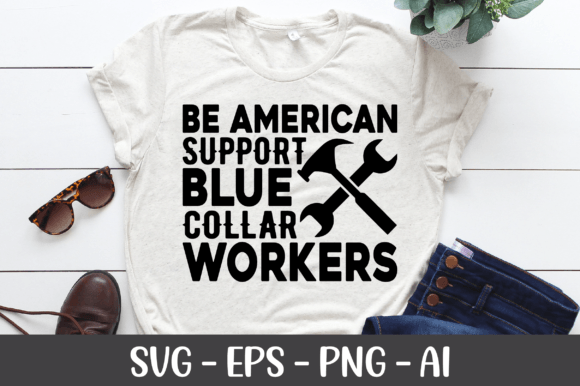
Be American Support Blue Collar Workers
A Designer’s First Look: Bold, Warm, and Purpose-Driven
When I opened the Be American Support Blue Collar Workers embroidery file, my first thought wasn’t about stitch count or file format—it was about resonance. This isn’t a decorative flourish or a trendy phrase; it’s a grounded, sincere statement with visual weight. The lettering is clean but not sterile—slightly rounded, with subtle thickness variation that suggests hand-drawn confidence. There’s no excessive ornamentation, no distracting icons or flourishes. Just strong, legible typography anchored by a quiet sense of pride. It feels like something you’d embroider on a sturdy cotton apron for a local mechanic’s shop—or stitch onto a denim tote bag sold at a regional craft fair. That authenticity matters. In a market flooded with generic “USA” motifs, Be American Support Blue Collar Workers lands with intention.
Real Project Test: A Custom Embroidered Tote for a Local Tool Library
Last week, I used Be American Support Blue Collar Workers on a 14-ounce canvas tote for a community tool-lending library—a small nonprofit that trains apprentices in carpentry and electrical work. We chose navy canvas, black thread, and a medium-density fill stitch for durability. The result? Crisp, professional, and deeply appropriate. Customers paused to read it. Volunteers smiled. One apprentice said, “That’s the first time I’ve seen something on a bag that actually *means* something where I work.” That reaction tells me more than any mockup ever could: this design carries narrative weight. It reads well at 3.5 inches wide—the size we used—and holds up even when viewed from across a room. No letter collapses, no thin strokes vanish under thread tension. For a craft business or Etsy seller building a niche around skilled trades, this isn’t just decoration—it’s alignment.
Where It Shines (and Where It Needs Care)
Be American Support Blue Collar Workers performs consistently across common handmade applications:
- Custom apparel: Works beautifully on sweatshirts and structured tees—especially over chest pockets or upper back panels. The balanced width-to-height ratio avoids awkward stretching on curved seams.
- Tote bag design & aprons: Ideal scale and clarity. Holds its shape without needing oversized hoops or heavy stabilizer.
- Embroidered patch: Clean outlines and moderate detail make it an excellent candidate for sew-on or iron-on patches—just confirm your digitizer keeps satin-stitch edges tight.
- Baby embroidery & nursery decor: Use with restraint. While gentle in tone, the message is adult-oriented—better suited for a dad’s workshop-themed baby blanket than a newborn onesie.
- Holiday embroidery & personalized gifts: Stitches cleanly on tea towels and pillow covers for Father’s Day, Labor Day, or small-shop holiday bundles. Pair with neutral thread (charcoal, deep rust, navy) for warmth without cliché.
But be thoughtful in these situations:
- Small hoop sizes (under 4 inches): The full phrase may feel cramped. Consider using just “Support Blue Collar Workers” if space is tight.
- Stretchy fabric or thin knits: Requires cutaway stabilizer underneath and possibly topping for crisp lettering—test first.
- Dark fabric + light thread: Avoid pale yellow or white unless you’re confident in your machine’s tension control. Opt for cream, oat, or slate gray for better readability and softer contrast.
- Curved surfaces (caps, beanies): The straight-line layout doesn’t wrap naturally—best placed on flat panels like front panels or side gussets.
- Frequent-wash items (kitchen towels, workwear): Confirm stitch density supports longevity—overly dense fills can stiffen fabric over time. A balanced fill stitch works best here.
What It Adds to Your Finished Product
This isn’t just another machine embroidery design—it elevates perception. On a handmade product, Be American Support Blue Collar Workers signals care, context, and connection. It builds customer trust because it feels earned, not slapped on. For an Etsy seller, it strengthens brand consistency when paired with complementary designs (think simple wrench icons or gear motifs). For a boutique owner, it adds giftability—people buy it not just for the item, but for the quiet affirmation it carries. Visually, it reads as professional without being corporate. And unlike overly ornate graphics, it doesn’t distract from the craftsmanship of the item itself—whether that’s hand-sewn seams on a linen pillow cover or the texture of heavyweight denim on a cap.
Practical Designer Notes Before You Stitch
Before committing to a client project or batch production:
- Test Be American Support Blue Collar Workers on scrap fabric matching your final material—especially if using textured weaves or blends.
- Check thread color contrast in natural light—not just screen previews. What looks bold on your monitor may mute on indigo canvas.
- Review stitch density: too sparse = fragile lettering; too dense = stiff, inflexible embroidery. Aim for balance.
- Confirm hoop size compatibility—some versions of this design may require a 5x7 or larger hoop for full integrity.
- Inspect small details: the crossbar on the “A”, the curve of the “R”—these define clarity at smaller scales.
- Run black-and-white mockups to assess value contrast on both light and dark backgrounds.
- Use proper stabilizer: tear-away for stable wovens, cutaway for knits or stretchy fabrics.
- Verify licensing terms before selling finished items or bundling the digital embroidery file with other design assets—this is a Graphics category download, not pre-cleared for resale as-is.
If you're sourcing Be American Support Blue Collar Workers for your craft business, remember: its strength lies in sincerity, not spectacle. It won’t dazzle with glitter or gradients—but it will resonate, endure, and quietly reinforce why people choose handmade, values-driven products over mass-produced alternatives. That’s not just good design. That’s good business.