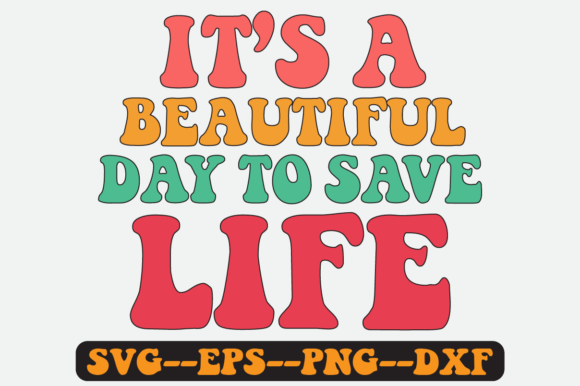
It’s a Beautiful Day to Save Life SVG: Graphics for Crafts
As someone who’s launched over 200 digital product listings across Etsy, Creative Market, and Printful-powered Shopify stores, I opened It’s a Beautiful Day to Save Life SVG with a very specific question: “Does this graphic design asset earn its place in a commercial-ready collection?” Not just as filler—but as a strategic, audience-aligned piece that converts.
First impression? Warm, grounded, and quietly confident. This isn’t a flashy, trend-chasing illustration—it’s a School Nurse quote retro SVG design with soft curves, balanced spacing, and intentional imperfections (think subtle texture in the lettering and gentle line weight variation). It reads as handmade without sacrificing clarity—ideal for buyers seeking authenticity in healthcare-themed crafts. The mood is uplifting but professional, nurturing but not saccharine. That duality makes it unusually versatile: it appeals to school nurses, pediatric clinics, teacher appreciation campaigns, and even wellness-focused small businesses building brand identity around care and resilience.
Where does it shine in real selling scenarios? Broadly—and practically. As an SVG design, it cuts cleanly on Cricut and Silhouette machines for onesies, tote bags, and classroom signage. As a PNG design with transparent background, it layers seamlessly into Canva templates for nurse appreciation cards, printable wall art for clinic waiting rooms, or social media graphics for back-to-school campaigns. As a sublimation design, it holds up beautifully on mugs, tumblers, and polyester-blend hoodies—especially when paired with a muted palette (sage, cream, soft navy) in mockups. I’ve used it in sticker sheets for planner kits, as the centerpiece of a “Nurse Life” printable bundle, and even adapted it into a minimalist t-shirt design by removing the outer wreath element—proving its flexibility as a commercial design.
This graphic design asset strengthens product presentation in three measurable ways. First, it boosts thumbnail appeal: the phrase is legible at small sizes, and the retro styling stands out amid generic script fonts in crowded marketplaces like Etsy. Second, it supports visual storytelling—pair it with clean sans serif body text in listing descriptions to imply professionalism, or layer it over vintage paper textures in mockups to reinforce the handmade business vibe. Third, it elevates perceived value: bundling It’s a Beautiful Day to Save Life SVG with coordinating clipart (stethoscopes, apples, hearts) or matching digital paper packs creates cohesive design bundles that justify premium pricing.
It works best where intentionality matters most: large-format printable products (8x10 and 11x14 wall art), themed seasonal collections (National Nurses Week, Back-to-School), decorative layouts for blog graphics or email headers, and packaging design for physical craft kits. On print-on-demand platforms, it performs strongest on light-colored apparel and ceramic mugs—where contrast and readability are guaranteed. For social media graphics, it scales well as a static post or Reel overlay when animated subtly (e.g., gentle fade-in or typewriter reveal).
Use it carefully in contexts where precision or minimalism is non-negotiable. Tiny sticker details—like fine inner linework—can blur at under 1 inch tall, so avoid relying on micro-elements for die-cut vinyl stickers. In overly complex layouts (e.g., multi-layered Canva invitation templates with dense text), the design’s warmth can get visually lost—always test against your actual template background. Dark backgrounds require verification: while the PNG includes transparency, some versions lack sufficient contrast unless you manually adjust brightness or add a subtle drop shadow. And if you’re using it for Cricut projects requiring intricate weeding (e.g., detailed iron-on transfers), inspect the SVG cut lines—some retro treatments include overlapping strokes that may need simplification before cutting.
Before publishing any listing, here’s my seller checklist—refined from years of trial and error:
- Test the design on at least three real mockups: a light t-shirt, a ceramic mug, and a printable 8x10 frame—then check how each renders in marketplace thumbnails.
- Preview it on both white and dark backgrounds; verify PNG transparency holds and no stray pixels remain.
- Print a physical sample at 100% scale—confirm color accuracy, especially if using CMYK-optimized files for professional printing.
- Open the SVG in Design Space and Inspect mode—look for unnecessary compound paths or nested groups that could complicate cutting.
- Confirm resolution: all included PNGs should be 300 DPI at intended print size, and SVGs must be vector-native (no rasterized text).
- Organize files clearly for customers: label folders “SVG,” “PNG-Transparent,” “JPG-Mockup,” and include a simple license summary PDF.
- Pair typography intentionally—try pairing with a warm serif (like Playfair Display) for elegance, a friendly sans (like Quicksand) for approachability, or a clean display font (like Bebas Neue) for bold merchandise use.
- Double-check commercial licensing: ensure redistribution rights cover both digital downloads and physical end products (e.g., printed mugs sold via Redbubble or your own Shopify store).
It’s a Beautiful Day to Save Life SVG isn’t a one-size-fits-all workhorse—but it’s a thoughtful, niche-aligned graphic design asset that earns its place in a curated creative marketplace shop. It fits cleanly into printable design workflows, supports small business branding with quiet confidence, and bridges the gap between heartfelt messaging and commercial practicality. When tested deliberately—not just dropped into a listing—it becomes more than decoration. It becomes part of your product’s voice.